segunda-feira, 31 de outubro de 2011

Notes #16 - Photography

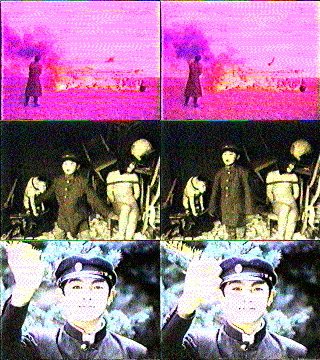
(Onna no Mizumi, 1966)

With no intention to shock or oversimplify things, I could say that photography, because it stoles movement from reality, is sin or I could just say that it cristalizes vision in a way totally foreign to our senses. But there's something perverse in the way it does so. Our eyes, in reality can't catch a glimpse of movement - if we are to be objective, our eyes can't really see anything, by that matter - but they have nonetheless a vague impression of it. Movement, it has to be said, introduces in us the destruction of objects seen by our desperate eyes, because everything that we see is a mere slave of time, and time waits for no man, time never waits for things to come.
The way our senses work recalls a lover that knows that his love is perishable, yet he chains himself to the opposite idea, pretending that the irreality of is foolish behaviour can overturn the real order of things. Our eyes have a paradoxical nature: they are slaves of movement, of death, but at the same time, they try to make things eternal. Such is the sad logic of cinema. The eye can't stand movement by itself, so it has to be accompanied by an eternal, sacred order that doesn't let things perish one after the other like birds in an hunting competition. The eye alone detaches reality from movement, but it never dares - because our senses are already given and can't be changed by will - to stole the movement from reality like photography does.
Photography is the eye free from the paradoxical nature of the senses, and because it is free, it is also sacred, like the soul that finally can abandon the body after its death. There is no movement in photography, there is no time in the strict sense, only a world of eternal shadows of something else, moments that have lost their life. The invention of photography is a sin, because it is a lie that impregnates the eyes with an impression of sovereign beauty and that beauty is indeed sovereign because it is never put to the test of movement, the test of ugliness.

sexta-feira, 28 de outubro de 2011

Notes #15 - Cinema (III)

(Sansho Dayu, 1954)


Uncertain radioscopy
like us
but probably exact
in the dosage between shadow and calcium
of its architecture
millimetrically internal,
at last
the spectacle turns
into the viewer itself
and now it dwells
the fluidity of blood:
every outside image
stuck to the frame that has been,
from eyeball to eyeball is destroyed.


-Carlos de Oliveira

domingo, 23 de outubro de 2011

The Kihachi Okamoto Touch


By Christoph Terhechte

Photographs of the director at work already spark curiosity about his films. Slender, casually dressed, with alert, intelligent eyes behind big glasses, his wild hair constrained by headgear of impressive variety, he has the nonconformist presence of a star. Maybe not a rebel, but certainly a free spirit and definitely incredibly cool.
Born in 1924, Okamoto Kihachi went to study in Tokyo at age 17. Convinced he would soon be drafted into the army, he spent every free minute at the movies. At the age of 19, he completed business school and took a job as director’s assistant with the production company Toho, where he initially worked for Naruse Mikio. When World War II brought film production to a standstill, he was assigned to work in an airplane factory. His draft notice did not come until the beginning of 1945, eight months before the end of the war. Okamoto later said, “You could say it’s a miracle I survived the war at all, since statistics show that the largest number of people killed were those born, like me, in 1924.”
After 1945, Toho hired him again as a director’s assistant under Naruse, but also with Taniguchi Senkichi, Makino Masahiro, Honda Ishiro, and Kurosawa Akira, before Okamoto had his first commission, in 1958, to make the comedy All About Marriage. One year later, he was able to film his own script, and the result made him famous: Desperado Outpost cast an irreverent gaze at the war in China; his protagonists were not heroes, but corrupt officers, bandits, adventurers, and crazy people.
With the “underworld” films produced by Toho, Okamoto turned to gangster movies. The second film in the series, The Last Gunfight, lent this genre the “Kihachi touch”: hired killers perform musical numbers, and Mifune Toshiro is an easygoing police detective who stands by a vengeful former gangster and engages in fistfights as if they were sword duels.
In Procurer of Hell , inspired by film noir, Okamoto again addressed the experiences of war. The corrupt factory owner whom small-time crook Tobe tries to blackmail with revealing photos turns out to have been his sadistic commanding officer on the front. And when the infernal blackmailer pair lies dying on the pavement at the end, it is no coincidence that Okamoto’s staging recalls a battlefield.
A popular genre of this time was the “salariman” comedies that reflected the new, Western lifestyle of the middle class. Okamoto left his stamp on these as well: in The Elegant Life of Mr.Everyman, not just with daring choreography and a montage that made original use of freeze frames. Once again, he used every opportunity to point to the wounds of the war. His son watching an American Western on television is already enough to rouse war memories in the hero. Okamoto used historical footage, satirical flashbacks, and even a sequence in the style of silent movies to point to war traumas.
Warring Clans and Samurai Assassin then fused elements from Westerns with the “chanbara” genre. Kurosawa had just shown how this could be done, and Kobayashi and Shinoda, too, turned upside down the lofty image of the edo era, which had been conserved in the “jidaigeki”. The honorable samurai were replaced by murderous, sinister characters who bring only suffering and death. Of course, the criticism was aimed not only at the Tokugawa period, which had vanished 100 years earlier, but more or less directly at every form of militarism. Okamoto’s The Sword of Doom, a frighteningly dark adaptation of the popular novel Daibosatsu toge by Nakazato Kaizan, is considered a masterpiece of this trend.
Although all earlier film versions of this material, always in the form of a trilogy, had been box office successes, Toho abandoned the plan of a sequel even before the film arrived at Japanese cinemas. This may indeed be the only work by Okamoto that was more successful in the West than in Japan.

(Kiru, 1968)

Okamoto returned to the “jidaigeki” again in 1968 with Kill, which is reminiscent of the Spaghetti Westerns of Leone and Corbucci. A year later, he cast Mifune Toshiro as Red Lion, who, with revolutionary ardor, champions the threatened farmers in the confused times when the Meiji empire replaced the shogunate. In 1970, in his signature role Yojinbo, Mifune then encountered Katsu Shintaro’s legendary Zatoichi. Zatoichi Meets Yojinbo was followed by more genre mixtures, for example the late, American-made work East Meets West, which follows a samurai through the Wild West.
A chronology of the events that ended World War II on August 15, 1945 appeared in Japan in 1965 under the title Japan’s Longest Day. The executives of Toho Productions decided to turn it into a representative docudrama for the company’s 35th birthday. With Okamoto directing, Mifune Toshiro in the role of War Minister Anami and Ryu Chishu as Prime Minister Suzuki head an illustrious troupe of Toho stars. Despite its length and the constraints of the prestige production, the film did more than illustrate the thesis that Japan’s worst enemy at the time was not America, but Japan itself. With The Emperor and the General, Okamoto also created an extremely suspenseful drama about a power struggle whose outcome was not clear until the end.
And yet the director was never happy with the result. The film presented the official history of the capitulation, not the perspective from which he himself experienced the end of the war. Just one year later, Okamoto tried to interest his production company in his own script, but Toho rejected it. And so Human Bullet (also known under its original title, Nikudan) became Okamoto’s first film for the independent Art Theatre Guild, shot with 16mm film material and a minimal budget. The hero of the satirical work is a 21-year-old soldier who bobs alone in the Pacific in a barrel with a torpedo attached, ready for his kamikaze mission. In fantasized flashbacks, we plunge into the world of his emotions and also encounter Ryu Chishu again, this time in the role of a bookseller left crippled by the war.
“Watching the two films together gives you a complete picture,” Okamoto said in an interview with an American film critic.
Okamoto Kihachi died on february 19, 2005. The forum is showing nine of Okamoto’s 39 films; that can hardly give a complete picture of his oeuvre, but it provides an inkling of what the “Kihachi touch” is: originality, elegance, a wealth of ideas, and a lack of respect for cinematic conventions – the work of a nonconformist.

(Dai-Bosatsu Toge, 1966)


Interview
(Peter B. High, “An Interview with Kihachi Okamoto”. WideAngle 1, no. 4, 1977)

Question: Though you’re also known as a director of samurai films, I’d like to concentrate on your war films. Why have you made so many?
Okamoto Kihachi: I certainly don’t make them out of any nostalgia. I spent three and a half terrible years as a soldier. Yet, even if modern gadgetry shortens future wars to a matter of days, the basic experience of men at war is universal. It will never change.

Question: The emotional tone of your answer suggests that you feel a sense of mission in making this kind of film. Is that true?
O.K.: No, nothing so pretentious as a “sense of mission”. My real drive comes from more private concerns.

Question: Your war films seem to fall into two categories: those large, epic productions you did for Toho like Gekido no showashi Okinawa kessen (The Battle of Okinawa, 1971) and the low-budget, personal ones financed by yourself, like Human Bullet and Tokkan (Battle Cry, 1975).
O.K.: Yes, the ones at Toho were expensive for the time, about uS$400,000. The budget for my personally financed films was one tenth of that. Of course, Japanese cinema simply can’t compete with the budgets of American films like The Longest Day. We’re forced to suggest entire battle scenes by showing small parts of the whole. Okinawa kessen is a good example, since the entire Japanese Army had to be represented by 15 actors and the American side by another 15 so even at Toho I was restricted to a rather puny scale. In Human Bullet I worked with only one character and in Tokkan, I had two. I was trying to convey the whole by portraying a mere part. So actually the budget in Japan doesn’t make very much difference after all.

Question: Did Toho lay down any rules or guidelines about how you should portray the war?
O.K.: No, there really weren’t any at all. They simply wanted to insure a financial success or rather, avoid losing money on a flop. That was their sole concern. The company made the big decisions about the kind of film to be made. Once in production, I had a fairly free hand. Of course, as time went on, their decisions became a real headache. Kiru (KILL, 1968), the samurai film with Mifune, was my last Toho film where I was free to choose the subject myself. After 1968, all my films were dictated totally by the company hierarchy. Both Human Bullet and Tokkan were written while I was still a director for Toho. I submitted both these scripts and negotiated with Toho about Human Bullet for three years. Needless to say, nothing happened and I ended up financing it myself. The same for Tokkan. financing films on my own was a nightmare, but emotionally liberating.

(Nihon no Ichiban Nagai Hi, 1967)

Question: So you were never instructed to avoid implying anyone’s war-guilt, or ordered to portray the war in a less than candid manner?
O.K.: No, not really. Well, I recall one restriction. When I made Nihon no ichiban nagai hi, I was told I couldn’t show the emperor on screen because the Keeper of the Privy Seal had sent instructions forbidding it. Of course, if I’d felt that it was aesthetically necessary to show him, I would have quit the project. Still, my purpose was to make a faithful depiction of the events during those 24 hours leading up to Japan’s decision to surrender: Having actors portray government officials was no problem because most are dead now and their faces are no longer familiar. But everyone knows the emperor’s face, right? using an actor for the emperor would have ruined the effect I was aiming for. My biggest problem was portraying the emperor through long shots, or by showing only his hands or his back. frankly, I’m still not sure I did the right thing.

Question: Was the problem simply that the emperor was still alive?
O.K.: Precisely. If it’d been emperor Meiji, it would have caused hardly a ripple. But the present emperor is a different matter entirely. right after the war, the emperor, who had long been considered a god, reverted to being a mortal human being, a citizen among citizens, and a familiar one at that. But now there’s a tendency to place a distance between him and the people again. So, strangely enough, if I’d made the film a bit earlier, I probably could have put him on screen.

Question: Was the company afraid of public outrage?
O.K.: To some extent, yes. It probably wouldn’t have amounted too much, but the company made the rule anyway.

Question: If you had made Japan’s Longest Day by yourself, would it have turned out differently?
O.K.: Actually, the issue goes deeper than that. If I’d been in complete control, my real problem would have been with the theme itself. I’d rather do a film about the opening days of the war than about the final days.

Question: But wouldn’t doing a film about the beginning of the war inevitably put you in the position of implicating someone with war-responsibility?
O.K.: I suppose so. But that’s not necessarily an ideological problem. for example, at the beginning of the war, the emperor couldn’t control the events which led us into conflict. But in the final phase, he did press for a decision to prevent the total extinction of Japan. Without his decisive action, I myself might not be alive today. So, you might say it’s the tale of how I personally survived the war. Still, this in no way explains how the war began. I believe the roots of the war can be uncovered only by looking all the way back to the period of a hundred years ago.

sábado, 22 de outubro de 2011

The Aesthetics of Japanese Cinema

(Akira Kurosawa)

1. The Tradition of the Aesthetic Consciousness in Japan

In this paper, I will investigate the tradition of the aesthetic consciousness in Japan substituting the aesthetic consciousness or the thought and expression of beauty for the term of aesthetics. The reason is that Japanese traditional consciousness of beauty is included in the films, a product of modern society, in various ways.
The aesthetic consciousness in Japan may be expressed by the two ways as follows; one is shown through works of art and the other is revealed in ways of living and of thinking or living itself. Both have been changing with the tendency of the times, but it is needless to say that the old taste doesnユt disappear but mingles and permeates into new one to flow deeply in the consciousness of people. Also, it is obvious that the origin of the Japanese culture itself has been influenced by other nations in Asia, especially, China and Korea, because it has been blended and stored with a variety of different races and cultures. Then, let's examine some main concepts related to the aesthetic consciousness in Japan.
There was an excellent opinion on the theory of poetry and of Noh drama in Japanese medieval times (12C - 16C) which is called Yosei and Yugen. Yosei means an emotion or a mood created beyond words. Such a thought of poetry Is very interesting, in that a great value is put on something beyond words although poetry is a genre of arts to be expressed in words. Yugen has the same meaning. It designates misty profound and subtle sentiments, and elegant and mild motions or beauty. Yugen is a temn of philosophy, thought Buddhism which was introduced from China, but has changed to be concept of traditional Japanese beauty.
Beauty of Yosei and Yugen can be replaced with the term of Sabi, which means a timeworn mood or loneliness to be common in Arabi (a desolate look), Sabi (an antique look) and so on.
In modern times (17C-18C), there were the words of Wabi Karumi and Mono no Aware (an awareness of the transience of everything worldly) in the theory of Sado (the tea ceremony), Haiku and literature. Wabi was concerned with a tranquil and plain flavor. Karumi, meaning lightness, is the simplicity shown in the supreme stage, which is opposite to boastful gravity or complicate skills. Mono no Aware is a feeling caused from the change of seasons, an intensive interest evoked by music or love, or an eagerness for things in the work. Besides, there is a tradition that makes much of leaving some spaces in a drawing paper in the theory of painting.
Considering these facts, it can be said that a suppressed expression or non-expressed expression is regarded as the best that reaches to the nothingness in the aesthetic conscious of Japanese people. Indeed, it may be connected to the Zen. Meanwhile, there is an expression which takes on full decorative property (e.g : the gold foil of some temples, Buddhist sanctums, mansions, ' etc.).

(Kamigami no Fukaki Yokubo, 1968)

Now, Iet's examine the aesthetic consciousness concerned with the ways of living and of thinking or living itself. Japanese is the agricultural nation, but there were some groups of wandering and roaming people such as lots of artists who led a vagabond life for their whole life, peddlers, aesthetics, etc.. Here, the theme of a wayfaring way or Michiyuki (a trip to the death) often repeats in Japanese films. The idea of transience produces the view of life and death accepting death, as a routine. The aesthetic consciousness to death is represented as Shinju (a lave suicide) that is characterized in the tragedy of Kabuki or Joruri. Also, there were the view of life and death of Yakuza, who thought of keeping an obligation to the last as a morality, and of warriors (Bushido) who considered a loyalty and a submission to be one. All of these beautify the attitude of accepting death as trivial.
If it is the aesthetics of the positive and that of victory to keep a life, we can say that the aesthetics of Japanese is related to that of the negative or a ruin. It is not simply defeat but ruin based on some righteousness. Such an aesthetic consciousness was visually stylized in Yakuza films which was popular in the 1960's.
In the other side, there were the traditions of Kabuki and paintings which showed a ferocious fancy, a ghost story and even bizarreness, Rakugo, a story-telling skill of traditional laugh, and shameless laugh, humor and satire shown in popular literature or paintings, contrary to the aesthetic consciousness concerned with elegance, Yugen, transience death. These traditions have something to do with optimism and realism, which choose grotesqueness rather than elegance and persistence rather than transience. Therefore, it can be called an anti-aesthetic consciousness, in that I satirizes the above-mentioned traditional aesthetic consciousness and violently upsets it. Such a strong anti-aesthetic consciousness is well exhibited in a director Shohei Imamura's works.

(Nora Inu, 1949)


2. The Expression of the Aesthetic Consciousness in Japanese Films - Suppression and Excess

Japanese films had been rapidly mass-produced after 1923, and then finally reached to its summit in the 1950's. In the 1920's (the silent picture days), Japan had already achieved a big film country following America in terms of quantity. But it did not get internationality because of the shortage of ability in terms of quality.
In those days, the characteristic of Japanese films was that, first of all, various tastes of directors could be engaged in making a film because lots of directors were needed for the mass production of films. Second. Japanese cinema developed its own distinctive features in theme, genre, aesthetic consciousness and the method of expression because it did not have international markets. Besides, there was great influence from European films.
In other words, the traditional aesthetic consciousness of Japan was influenced as immensely by Europe as by many Asian countries including China and Korea. Generally speaking, if you could pick up two of the specific characters of Japanese films among others, they might be suppression and excess. While suppression means to press down expression, not ex-press (push outside) but in-press (pushed inside). That is to say, it is to control and make calm not to express some desires or feelings, and not to explode. Excess means to push fervently an expression toward outside, namely, to express some desires or feeling, and to go off. Yasujiro Ozu is regarded as the representative of suppression films.
There are a tension between inactivity and activity, a vivid contrast of light and shadow, and the dynamics of motion in Akira Kurosawa's works. In his films, there are some excess of expression and the emotion of energy like heavy rain, gale, the burning sun, etc. Such excess which intensely pushes ego toward the outside is explicit in visuals as well as actions, and it can make itself understood internationally. Thatユs why his films get a good reputation widely in the world. Also, his works have the excess of a view of morality of enforcing humanism as well as that of expression, and make spectators embarrassed or moved. The excess as the expression of the manhood may appeal to less female than male. Mr. Donald Riche, well known for his introduction of Japanese films to foreign countries, has praised for Red Sorghum, a Chinese film, on the ground that it reminds Rashomon. Ahang Yimou's Rod Sorghum has a heroin but depicts not so much the expression of the womanhood as that of a strong ego and self-assertion. And in his other works, the excess and vividness of color can be well observed, too.
Kurosawa's noticeable features can imply the following. He began as a painter and was interested in Japanese traditional artistic accomplishment like Noh drama, which greatly influenced the beauty of style of his works. Both Nohユs restrained expression and Kurosawa's excessive one do not contradict, but are related with each other in a dynamic tension within his films to complete his unique and consistent features under his aesthetic consciousness.

(Wandafuru Raifu, 1998)

Director Shohei Imamura is same in the light of 'excess', even though his works display the traits of more 'suppression' than 'excess' as shown in Woonagi (The Eel) and Black Rain. But his works can be distinguished from Akira Kurosawa's ones, if same in excess, in that the former works contain the spirit and consciousness of an intensive anti-aesthetic. He expresses the power of life, straightforward desired and trivial comedy of worldly human beings with some distance, rather than the beauty of an image or a composition. From this distance, there is created a laugh which is not ridicule but sympathy with common people. It seems that Imamura's true characteristic is an endless interest in a falling man and popularity going through his works with something secular. Meanwhile, the works of Takeshi Kitano, who directed Hana-bi, are the films of suppression in general. Except A Scent At The Sea(91), Kids Return(96), some unexpected violence are hidden in his works. Hana-bi has a man of few words and suppressed dialogues, but hidden violence take on a sudden and excessive property in it. This excess make spectators shocked. Be it ever so physical and bodily violence, this is something to be felt an airs of nihilism and pessimism which come out of the fissure of his existence, and to transcend beyond words, reason and logic.
Characters who are similar with the hero of Hana-bi distinguished in Japanese films to win a prize in international film festivals, for example, Kohei Oguri's Nemura Otoko(Sleeping Man), in which Ahn Sung-ki, a famous Korean actor, appears, Hirokazu Koreeda' Light of Fantasy, Naomi Kawase's Moeno Suzaku, Makoto Shinozaki's Okaeri and so on.
In fact, the expression of 'suppression' can be found in many films all over the world, too. A Taiwan film A City of Sadness and an Indian film Song of the Road are good examples. And in Korean films, director Im Kwon-taek's works Jokbo(The Family Tree Book), Sibaji(A Surrogate Woman), Sopyunje, etc. can be counted in. But strong pathos is fully contained in his works.
As a result, both 'excess' and 'supression' may be excessive elements of all nations only in terms of an abstract meaning. The points are whether such expressions are unusually much involved in Japanese films and whether they include the characteristics peculiar to Japan.

(Naoto Takenaka filming Muno no Hito, 1991)

3. The Expression of the Aesthetic Consciousness in Japanese Films - Death and Revival

Since the days of mass-production(from the 1920's through the 1960's), Japanese films have achieved to group various genres of films, regardless of good works by outstanding directors. Among the various genres, there is a genre, the period/costume film, which exhibit an aesthetic consciousness. The costume play can visualize the way of living of old Japanese before some influence from Europe as 'a kind of lost beauty today'. During this Asian Art Film Festival(from 6 Nov. to 20 Nov. 1998), three Jidai-geki(period/costume film) will be presented; Rashomon, Gate of Hell and Bushido-Samurai Saga(directd by Tadashi Imai). Muhomatsu no Issho(Life of Matsu the Untamed) can be added to them, it terms of 'beauty of lost life and feeling'.
Strictly speaking, it is true that these films deviate from the category of the Jidai-geki film. Rashomon and Gate of hell play with a medieval times older than Edo times, and Muhomatsu no Issho represents the times after the influence from Europe. Involved in the category of the Jidai-geki film Bushido-Samurai Saga tends to destroy what can be expected by spectators in films ミ explicit confrontation between good and evil, aesthetics of Tate(action in sword) and Tatharsis resulted from them.
Seen by foreigners, these films may have merits to posses both beauty of style as a costume play and some exoticisms referred to genre film, thinking that the populace's and aesthetics consciousness and the aesthetics of their living and feeling and reflected on a group of films which have grown to series of mass-production apart from Japonism. And in terms of them, I think genre film includes the hope, dream, purification passion and grudge of people.
However, genre film was forced to decline in Japanese film circles after the appearance of TV in the 1950's. The turned period was the middle of the 1960's, when Yakuza-film appeared. The background of Yakuza films as Meiji Restoration days(the end of the 19th century--the beginning of the 20th century) after Edo times passed away. This genre expressed something old and what is sinking as the good and beautiful, and something new and what is rising(above all westernization) as the evil=the ugly.

(Showa Zankyo-Den, 1965)

It is important that the last genre film expressing 'beauty of lost living and feeling' flourished in the high growth period of Japan in the 1960's. It means that Japanese traditional morality and aesthetic consciousness, especially those of the masses, have a transient prosperity within Yakuza film, a kind of genre film.
According to Takenobu Watanabe, a critic in those days, the appeals of Yakuza films are as follows; The first is the antagonism between things old and new, the second is the conflicts of interests(in life or economy), the third is the confrontation between things refined and rough, and the last is the opposition things harmonious and disharmonious. These four pairs of confrontations are visually expressed in Yakuza films.
Yakuza films don't stand for the male society in general, because there appears 'beauty of life and feelings in the male world' rather than 'beauty of lost life and feelings', and a number of Yakuzas come out there. Therefore, it seems proper to classify these films as a variant of the costume play as well. Except for current Yakuza films to screen a Japanese society after World War II, classical Yakuza films conserve the grudges of the old and the weak who are oppressed by the modern industrializing society and are disappearing from that society. Similarly, 'suppression' of patience and 'excess' of explosion of violence(or feeling) are true of Yakuza films, too.
Above all, it is most important in this genre that a man running behind others fulfills the ethics through death to get society, morality, justice, principle of 'revival through death' and 'the aesthetic of defeat'. As for Hana-bi again, only Hana-bi leaves a little bit airs of Yakuza film among the films which will be shown at the Asian Art Film Festival at Seoul. Of course, Hana-bi doesn't follow the pattern of Yakuza film as a genre. Its background is the present day and its here is not a Yakuza but an ex-policeman. So, Hana-bi resembles and American hard-boiled play, a film where a tough detective appears.
It is significant that the last scene of this film accords with some part out of the classical aesthetic consciousness. Also, it is obvious that grand prix winning works are the excellent accomplishments of directors of marked individuality. The aesthetic consciousness and anti-aesthetic consciousness of Japanese are flowing in those works. However, it is impossible to guess the variety of Japanese films only with grand prix winning works, whether it is an old film or a new one. What kind of the aesthetic consciousness is in the current Japanese films, from which the Jidai-geki film and Ninkyo(yakuza) film almost have disappeared?
What is the aesthetic consciousness of Japanese which is common in such my recent interested films as Shunji Iwai's Swallowtail, Naoto Takenaka's Tokyobiyori and Kiyoshi Kurosawa's Cure.
It is apparent that the aesthetic consciousness of Japanese consists of many elements unexplainable any more only with the traditional aesthetic consciousness of Japan or the East, including the influences from Europe.
If more Japanese films can be screened in Korea, Koreans may get faster aware of these facts than Japanese. Seen out of the country by other people, the remarkable features of a matter will be well grasped unexpectedly.

-By Kenji Iwamoto
(Symposium for the Asian Art Film Festival, Seoul, 1998)

domingo, 16 de outubro de 2011

From Propaganda To Reflection: How Japanese Cinema Has Dealt With World War II

(Nihon no Ichiban Nagai Hi, 1967)
By leakbrewergator
(History Forums)

Japan entered World War II as a nation that had not been conquered in its entire history. In fact, at the time of the Battle of Midway in 1942, Japan had gone nearly 3 and a half centuries without a single defeat. Not since the Japanese retreat from Korea in 1597 had Japan’s military been repelled. Japan had been at war since its occupation of Manchuria in 1928.For nearly 14 years, Japan’s military had enjoyed staggering success in its quest to create a Pacific Empire.
Of course Japan’s success would not last for very long. After the Battle of Midway, and with America’s “Island-hopping” campaign in the Pacific, Japan suffered defeat after defeat. The atomic bomb brought a sudden and dramatic end to Japan’s quest for Empire. Japan now had to deal with something that it had never had to deal with before: defeat.
Japanese cinema has not dealt with World War II in the voluminous manner that most Western nations have. Nevertheless, the film industry of Japan offers a great deal of variety when it comes to World War II cinema. The cinema during the war was, of course, entirely propaganda. The films were usually commissioned by political leaders and were used to hide the mounting losses of the war to the Japanese people. The post-war (Showa) period of Japan focused on separating the present from pre-1945 Japan. After the Showa period, Japanese World War II films can be divided into two distinct categories: that of anti-war films and films that show Japan as a heroic combatant that was unmercifully bombed into submission with a new and terrible weapon. This incredibly fascinating blog post will discuss the transition of Japanese cinema throughout these periods.
Japan during the war years was a very rigid hierarchical society. Highly restrictive institutions were established to keep a populace in check during a period that saw Japan’s entrance into the war as well as a tremendous depression. The sole purpose of schools during this period was to indoctrinate children to a militaristic society that was wholly devoted to the service of the Emperor. These teachings would gain even more significance after what is internationally known as the “Manchurian Incident.”
The Manchurian Incident involved the Japanese occupation of Manchuria after a mysterious bombing of a railway in the Chinese province in 1928. This incident along with the Japanese invasion of Indo-China set Japan on a collision course for war with America.
The Japanese attack on Pearl Harbor on December 7, 1941 officially made Japan and the United States combatants in the war. Pearl Harbor was an absolute success for the Japanese military machine. This success would be used in a purely propagandist film a year later in a movie entitled, Hawai Mare oki Kaisen (1942). The War at Sea From Hawaii to Malay, as is its English title, was directed by Kajiro Yamamoto. The film was made to commemorate the one year anniversary of the attack on Pearl Harbor. The film showed the complete destruction of American ships by Japanese dive bombers and was the pinnacle of Japan’s propaganda films. Despite the film’s subject matter, Yamamoto put together an exquisite combination of real footage and battlefield reproductions using miniatures. Yamamoto’s film would be used in the later years of the war as a means of boosting public morale.

(Nihon no Ichiban Nagai Hi, 1967)

Taking into account Japan’s political climate during the war, it is not surprising that the first anime film to ever be created in 1945 was a propaganda film. Matsuyo Seo’s Momotarō: Umi no Shinpei or Momotarō’s Divine Sea Warriors was the first propaganda film geared towards children to be made during the war in any nation. The anime glorified Japan’s occupation of Asia. The movie went along with the official government’s statement that Japan was “liberating” its Asian neighbors from harsh colonial rule. Divine Sea Warriors followed a group of animals dressed as Japanese pilots as they traveled through their newly conquered lands. The entire film was set to an eerie chorus of children singing throughout the background.
Both The War at Sea and Divine Sea Warriors are exemplary films, albeit entirely propaganda. Both of the films would be shown repeatedly throughout Japan until the American occupation of Japan at the war’s conclusion. The American occupation itself ushered in a new period of Japanese film making and the way filmmakers dealt with World War II as a topic. This period is known as the Showa Period.
The Showa Period in Japan is marked by political uncertainty and tremendous social change in the archipelago. Despite the political and social upheaval, the Japanese film industry continued to produce films about the war. As was discussed earlier in this essay, the Japanese felt that the films of post-war Japan should distinguish themselves from those of pre-war Japan. This was due to the fact that the Japanese believed that there was a need to separate their current situation from the “polluted” past.
Contrary to the propaganda films of the war years, the post-war films showed the Japanese as victims of the war. They were victims of subtle Allied aggression, Chinese nationalists’ attacks, and most importantly, themselves. This latter victimization is known as “self-victimization.” The Japanese people felt that they had fallen victim to pre-1945 militarism and that their military had been dragged into the war by an elite few who would benefit from the war. This theory can be seen in many popular movies later in this period. Yamamoto Isoroku (1968) and Okinawa Kessen (1971) were among the most popular of these films.

(Gekido no Showashi: Okinawa Kessen, 1971)

Both of these films portrayed the Japanese as “good, sincere people who were forced to go to war.” These films also showed that the Japanese people suffered greatly as a result of the decision to go to war. Both of these films were also popular because they contained great visual effects for their time and they all focused on famous battles during the war. Yamamoto Isoroku was directed by Masuyama Seiji. The film starred Toshirō Mifune as Admiral Yamamoto. While the film was more of a biography of the much admired Yamamoto, the apex of the movie was a vivid account of Pearl Harbor. Okinawa Kessen is considered to be director Kihachi Okamoto’s greatest masterpiece. The first half of the film is dedicated to the planning and build up of the Battle of Okinawa. The second half of the film gruesomely portrays the actual battle itself. Perhaps no film of this era has ever captured the suffering of Japanese civilians as Okinawa Kessen. Many later anti-war directors would use Okamoto’s film as a template.
Many directors used World War II and Japan’s defeat as a means to scrutinize Japanese society as a whole. This can be seen in Kunio Watanabe’s Meiji tennō to nichiro senso (English Title: The Emperor Meiji and The Russo-Japanese War) (1958). This film drew a comparison to the Russo-Japanese War of the early 20th century and World War II. The Russo-Japanese War was portrayed as Japan’s “Good War.” On the other hand, Japan’s involvement in World War II was portrayed as disastrous and ill-conceived. Emperor Hirohito was even portrayed as a less than capable leader. This is something that would have been inconceivable just a few decades earlier.
Another film that scrutinizes Japanese society and its involvement in the war was Storm Over The Pacific (1960). Storm Over The Pacific follows Lt. Koji Kitami played by Yosuke Natsuki throughout most of the war. Kitami is a pilot aboard the aircraft carrier Hiryu. Kitami remains loyal to his belief in the leaders of Japan’s military throughout the rousing successes of the early Pacific War. However, after the Battle of Midway, Kitami’s faith becomes incredibly shaken. Director Shūe Matsubayashi does a tremendous job of portraying post-war Japanese sentiment about the war through Kitami’s thoughts and dialogue.
One theme that was established in Japanese World War II films during the Showa Period that would be repeated often in later films would be that of the atomic bomb. The atomic bomb became the most powerful symbol of Japan’s defeat during this period. Japan’s Longest Day (1967), directed by Kihachi Okamoto shows the internal struggle that took place among Japan’s leaders on the issue of surrender after the atomic bombs. The film shows that the only reason why the side favoring surrender won out was because of the advent of these new and devastating bombs. Horikawa Hiromichi’s Gunbatsu (1970) also relied on this theme. The film itself was a crude biography of General Tojo that would later be used as a template for modern Japanese “Heroic” World War II films. The film shows that General Tojo was forced to accept Japan’s decision to surrender only after the bombs were dropped on Hiroshima and Nagasaki.
The atomic bomb would play a pivotal role in later Japanese films. Both anti-war films and Heroic Japan films would use the atomic bomb as a mechanism to further develop their stories.

(Hotaru no Haka, 1988)

As I have mentioned earlier, Japanese World War II cinema after the Showa Period can be divided into two distinct categories. There are movies that are entirely anti-war. These films argue that the cost of lives and human suffering do not outweigh the potential gains of the war. The fact that Japan lost the war adds more strength to these films' arguments. On the other side of the spectrum are the films that I have defined as “Heroic Japan” films. These films tend to focus on the brave individuals who fought in the war and not the war itself. The “Heroic Japan” films also tend to point out that Japan was only defeated by a devastatingly terrible weapon and not an invading army. The “Heroic Japan” films are usually met with strong public opinion and controversy. However, they tend to achieve greater critical acclaim than their anti-war counterparts.
Anti War films in post Showa Japan have one major common characteristic. They show the plight of all those affected by the war. Perhaps no film has captured this better than the Human Condition trilogies. This trilogy is entirely anti-war and used the experience of one Japanese soldier to point out the evils of war. Kaji is the main character of the trilogy. Director Masaki Kobayashi sets the tone in the trilogy’s first film, No Greater Love when Kaji refuses to follow orders and abuse helpless Chinese prisoners. Kaji continues to see the worst of human kind as he faces hopeless battles and eventual capture throughout the next two films of the trilogy: Road To Eternity and A Soldier’s Prayer.
Another major focal point of the anti war films is the atomic bomb. The devastation and mass suffering that the two atomic bombs caused is often used as a vehicle for anti war films to drive their points home. Two films in particular have captured this thought brilliantly. Grave of The Fireflies (1988) and Black Rain (1989) both captured the suffering caused by the atomic bombs in very vivid detail.
Grave of The Fireflies, Japanese name Hotaru no haka, is an animated film directed by Isao Takahata. This film focuses on the atomic bombs as well as the firebombing of Tokyo. The film focuses on two children that have lost their father in the military as well as their mother in the firebombing of Tokyo. Grave of The Fireflies is the epitome of an anti war film. Takahata refused to glamorize the war as a heroic struggle. Instead, he showed the war as a horrific experience for normal civilians that lived in Japan at the time.

(Kuroi Ame, 1989)

One year later, director Imamura Shohei released his masterpiece, Black Rain (1989). Black Rain is a black and white film about the bombing of Hiroshima. The film follows a group of survivors that lived on the periphery of the explosion. Instead of focusing on the bomb itself, Black Rain shows the devastating long term effects of the weapon. A group of survivors stumble their way through the rubble of a destroyed Hiroshima helping rescue workers look for other survivors. The film derives its name from the black tears that one of the survivors produces when she begins to cry. It is later learned that the tears turned black due to her exposure to the vast amounts of radiation in the city. Black Rain also shows the plight of the rescue workers who suffer from their exposure to the radiation. Shoei’s filmis still considered the greatest “horrors of war” film to have ever been made.
The second type of Japanese World War II cinema in recent years can be classified as “Heroic Japan” films. These films tend to focus on the individuals in World War II and even go as far as justifying the war in some instances. One such film that focuses on one very controversial figure is Pride (1998). This film depicts Japanese wartime Prime Minister, General Tōjō Hideki as a heroic leader that is vengefully hounded and executed by the conquering allies.
The interesting aspect about Pride is that the film reverts back to the propaganda films that dominated Japan during the war years. Pride was funded by right-wing ideological interest groups that sought to restore Japan’s past glory as a military power. The film argued the viewpoint that Japan should have been exonerated from its war with China at the onset of World War II because they were provoked into war by Chinese Communists. Pride was met with very stiff public protests in Japan as well as in China due to its controversial subject matter.
The “Heroic Japan” film has dominated the recent releases with the World War II genre in Japan. Two recent films that I have classified in this category are Lorelei: The Witch of the Pacific Ocean (2005) and For Those We Love (2007). Both of these films did tremendously well at the Japanese box office despite being met with protests overseas.

(Ningen no Joken, 1959)

Lorelei: Witch of the Pacific Ocean was directed by Shinji Higuchi and released in 2005. The film features a fictional Japanese submarine that successfully thwarted a third atomic bomb attack by the United States. Lorelei was heavily criticized for its glorification of Japanese exploits during the war. The movie also rekindled an old Japanese notion that the Axis powers were in fact victimized by the war. The notion that the Allied powers were willing to drop an atomic bomb on Tokyo was another aspect of the film that invited heavy criticism. This was used to further illustrate the film’s point that the Japanese were indeed the victims. Despite the film’s controversies, Lorelei uses an impressive combination of special effects and story telling that made it a huge success in Japan.
Taku Shinjo’s For Those We Love was released in 2007 amid a tremendous amount of protests from Australia. The film was the first feature film to deal with the infamous kamikaze pilots of World War II. Shinjo did a masterful job of showing the kamikaze pilots in a very humanizing light throughout the film. For Those We Love often showed the pilot’s dilemma of dying in the service of their Emperor, whom they loved, and surviving the war to be with their families, who they obviously loved as well. The film’s controversy begins when the kamikaze pilot’s actions are often glamorized throughout the film. The pilot’s suicidal plunges into Allied warships are shown as being very courageous and honorable. On the other hand, the film portrays the Allied forces as brutal aggressors with no honor or sense of service.
With the recent success of these “Heroic Japan” films, there is no reason to doubt that they will continue to be produced even in the face of foreign criticisms. Often times these films have higher budgets and attract better directors and more well known actors. There are still dozens of World War II films that can be made for Japanese audiences. Perhaps there will be a new found appreciation for these films so that there will no longer be a dearth of material available for those who wish to study World War II films in Japan.
As one can see, Japanese cinema has portrayed World War II in many different fashions. First, Japanese World War II films were entirely propaganda. This was necessary due to the circumstances surrounding the war at the time. The films of Showa Period Japan attempted to separate Post-War Japan from its Pre-War society. More recently, Japanese cinema has been divided into two distinct categories. That of anti-war films, and those films that portray Japan as being heroic and honorable throughout the war. All of these films show a great deal of how Japanese society as a whole chooses to deal with World War II and the Japanese role in it.