Mostrar mensagens com a etiqueta Studies. Mostrar todas as mensagens

sábado, 6 de novembro de 2010

Studies #4 - Motoharu Jonouchi's Gewaltopia Trailer


Description #1

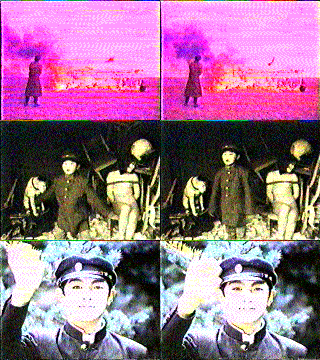
The title Gewaltopia Trailer (1968) has a dual meaning in the Japanese language; one meaning for the word yokoku (trailer) could mean a compilation of extracts to promote a film, but it can also mean a prediction, a prophecy for the future as a Gewaltopia (Gewalt=violence + Utopia). The film accumulates footage from his earlier films and arranges them in different contexts, a characteristic style of Jonouchi’s who often re-edited his films for each screening and provided different soundtracks. The jarring aural atmosphere, exemplary of the emergent noise-music scene, haunts the screen in an oppressive hypnosis and will seduce you into entrancement.

(Gewaltopia Trailer, 1968)
Description #2

Jonouchi’s “Gewaltopia Trailer” (1968) intersperses student protests at Nihon University with a swirling arsenal of images: mushroom clouds, excerpts from Nosferatu and King Kong, and people with writing tattooed or printed on various areas of their bodies. The soundtrack is a mix of anguished human voices and eerie electronic music.

(Gewaltopia Trailer, 1968)


A little introduction about Jonouchi

Born in 1935, in Ibaragi Prefecture. Jonouchi entered the Art Department of Nihon University; in 1957, along with his colleague Katsumi Hirano, he co-founded the Film Study Group in the Fine Art Department of Nihon University. He co-directed “The Record of N [N no Kiroku]” (59), the second production by the collective, documenting the disaster of the Ise Bay Typhoon. “Pou Pou” (60) is a chain of amorphously expanding phantasmagoric images, with insertions of the images taken from film classics. During the same period, looking ahead to the future after graduation, he co-founded the VAN Institute for Cinematic Science as a forum for film production, and began living communally with five members including Masao Adachi. In correspondence with the anti-art movement of the time, VAN Institute assumed a place for artists working in various media to gather together. A documentary of the Anti-Japan-US Security Treaty struggle of 1960, “Document 6.15” (61), was screened at the memorial assembly for Michiko Kanba, who was killed at the demonstration in front of the Diet Building. It was a pioneering experiment of ‘intermedia’ in Japan which showed symbolic close-up images of Kanbara along with the scenes re-enacting police brutality, meanwhile two completely different soundtracks were played together, slide projections of paintings were going on, and a live happening was taking place at the venue. Jonouchi subsequently produced “Document LSD” (62), documenting a public LSD experiment using himself as the object; “Hi Red Center Shelter Plan” (64), that was about an art event at the Imperial Hotel; “WOLS”(65), consisting of fragments of a painting by WOLS, which were put together through in-camera editing; “Hijikata Tatsumi,” which shot the stage of Tatsumi Hijikata frame by frame. Towards the 70’s Anti-Japan-US Security Treaty Struggle, he continued to document the student uprising, while successively producing the “Gewaltopia series” including “Hakusan Street by Nihon University [Nichidai Hakusan-dori]”(68), “The Mass Collective Bargaining at Nihon University” (68), “Gewaltopia Trailer” (69), and “Shinjuku Station” (74). By including live performances which created improvised sounds and editing the films differently for each screening, and thus negating the idea of film as being complete, repeatable, and consumable — Jonouchi pursued ‘cinematic revolution.

sábado, 14 de novembro de 2009

Studies #3 - Pastoral's Hieratic Chess Scene


Highly symbolic (in the verge of obscurity), Pastoral: To Die in the Country by Shuji Terayama tries to grasp obsessively the memories of its own author. Time, as we understand it, can only be perceived as a slowly and severe destruction of bodies.In this hieratic and complex scene, we see the film's director playing shôgi (japanese chess) with himself, twenty years ago. Let's see how Terayama - with the help of symbols, metafors and a deep sense of irreality - communicates a nostalgic, cinematic vision of his own life.


1st cut [00:00-00:43] - Although the camera stands still in its absence of movement, the framing is very complex, thus destroying a single reading. Comunication in Terayama's work is often given in poetic ways, that is to say, in a deep effort to symbolize reality. The truth is that imagetic poetry (or cinematic poetry) uses symbols to confine reality into a meaning, but creating a symbol is also playing with its natural ambiguity. It always goes through multiple readings. That is why Terayama's symbols, sounds and poetic imagery are intrinsicly associated to his life experience. Some of them are strange for us, (and therefore, close to him) but others are related to universal meanings. We often understand cinema as a general experience, which is to say, an experience made by everyone to anybody. In Terayama's poetic cinema, the artist drags every viewer into a single experience made by multiple readings lost in the creative process. Therefore, Terayama's cinema is an experience made by one to everybody turned now into another.
As we can notice, there are three main images happening in the first cut: the shogi game of the main characters, a little boy getting his hair cut by a barber and a young man leaving his country, supposedly going to war. Each one of these happenings will be transformed thus representing the anarchic and unstoppable flow that, ultimately, time is. Terayama, as we can see, tries to film time, the slow-turned-into-quick changing of things:

1st cut
Just look at the farewell ceremony of the young man leaving his village on the picture above. We know he'll certainly die for his country. Meanwhile, the two main characters (which will be refered from now on as I-Young and I-Old) talk about game choices.

1st cut
We notice a subtle ellipsis as if the war had already finished. Now, the man returns to his family with the embers of his dead fellows. Terayama's memory of war experience is still very present (his father died in the II World War).
The cinematic space turns into theatrical space (the camera is still although everything seems to happen). The local of drama communicates, first of all, the experience of loss. And time itself is the greatest loss. An eternal loss of the same turned into another.

2nd cut [00:43-00:46] & 3rd cut [00:46-00:51] - I-Young and I-Old talk about the irreversibility of time. Freedom doesn't exist if someone talks with his older self. The future revealed to the present can only be perceived as a deterministic prison in which the present can't escape. Such is the same with the past revealed to the present: if a thing like that would exist it only would predict the mechanisms of the being here and now. Hence, the present time is a prison between the previsibility of the past and future. The dice are already thrown. Freedom is a nostalgia of its absence.

4th cut [00:51-01:04] - Time waits for no man and in a sudden move of opacity, everything changed in the background. Look what happened to the child on the barber seat:
4th cut
He has been transformed into a grown-up as we can notice in the image above. The very instant of having his hair cut is the same vertiginous moment of the continuous death of beings. Meanwhile, a man and a woman lay in the grass, preparing to make love as a silhouette slowly leaves the framing on the background. The recurring theme here is escaping as the mirror reflects our condition, as beings trying to escape time's cage and cruelty. The film itself is a mirror.
Terayama is playing with space and time relations, creating chaos when filming. Thus, in this inner journey of searching time, we never reach a non-time but the sum of temporality. The word here is not transcendence, but poetic freedom through excess.

5th cut [01:04-01:06] & 6th cut [01:06-01:31]- Very quick take (almost subliminal) showing the couple making love, as we cut back to the main framing.

7th cut [01:31- 01:37] & 8th cut [01:37 -02:20] Following cut 6th, another adult sits on the barber chair. Then, on the 8th cut we notice he has been again transformed into an old man:
8th cut
Meanwhile, a marriage crosses the framing. Time is also seen as repetition of ceremonies. But the act of portraying it wants to be free from this sad circularity. I-Old then says everything: " You can't make time stand still."

9th cut [02:20-02:53], 10th cut [02:53-03:00] & 11th cut [03:00-03:20] - Digression on subjective memories of mother through a green filter. Or the violation of innocence. Because they're the most subjective memories they're also the most haunting. Though we can't grasp the total meaning of these takes, we can say this: innocence is being shattered by sensual knowledge, everywhere. Our mother happens to be exactly the same as in the 10th cut: an older woman that has within her, the hiding face of a yonger self. Earlier in the film, Terayama had already built the perfect cinematic image of this. A blood stain spreading through a white screen. Now he underlines it with the firefly burning the house out of rage. That is to say, the profond violence of loosing innocence through carnal knowledge.

11th cut [03:00-04:37] - The shôgi game continues. A little girl sits on the barber chair. A man speaks to the camera in a cinéma-verité way, thus killing the concept of a viewer's theoretical abstraction. "You in the stalls, one of those days you'll croak too!" This is for us, all of us. "We're all flowers, we soon fade". Here, the selfish monologue turns into objective madness. Time we'll kill us all. The sorrowful way of filming contains the truth of a scream.

12th cut [04:37-04:44] & 13th cut [04:44-04:53] - I-Old and I-Young are filmed from the back.

14th cut [04:53-05:43] - I-Old and I-Young are still playing shogi. The idea of playing is essential. It recalls us the famous scene in Bergman's Seventh Seal, where death plays a game of chess with the knight, and wins. Here, I-Old wins the match against the I-Young. It was impossible for I-Old to lose. "He knows everything about I-Young but I Young does not know anything about him."
Meanwhile, a door is standing on the back. That is, in fact, a kekkai. We should recall what architecture critic Itô Teiji writes about this subject:
«A kekkai-- a marker which separates the spaces on both sides of it […]—can be a fence, a screen, a rope, a shadow on a paper door, a light beam, even a sound. [….] Kekkai, which originated in primitive Shinto and were systematized in esoteric Buddhist philosophy, are deeply rooted in Japanese traditions not only as simple markers that symbolize boundaries, but also in the special architectural devices that physically partition space.»

14th cut
14th cut

What is this kekkai separating, then? The real from the unreal? Subjectivity from objectivity? We should say, life from death. As we can see later, a funeral procession crosses the framing, thus finishing all the ceremonies (1ºWar, 2ºMarriage, 3ºFuneral). The kekkai is separating the present from the future, not allowing one to cross the other entirely. This may seem contradictory to what we already said. But when it comes to death (the only future, the unique, possible end of all things) neither past nor present, nor a near future can see it clearly, although we know it will happen. The kekkai is a symbol of a necessary division. Death can't be seen as an open door. On the contrary, a closed door, separating the inside from the outside suits better this image of silence. At this point, we reach the idea of impossible, whithout noticing. Absolute time is an impossibility. It's the vertigo of death and silence. And it is with this image of pure stillness, that the scene ends, opening way to nostalgic visions of the absolute.

domingo, 8 de novembro de 2009

Studies #2 - Shura's Opening Scene


Shura by Toshio Matsumoto is a demoniac experience, a cinematic nightmare which uses tension in order to build the slow destruction of a man haunted by his tragic fate. Let's see how the opening creates a dream-like atmosphere of a terrific huit-clos without exit.


1st cut [00:00-00:06] - Production Names.

2nd cut [00:06-00:44] - The colorful setting sun plunges the movie into darkness until its very end. Cinema reveals itself as the despair of night.

3rd to 9th cut [00:44-02:24] - Opening credits. A monk rings the bell as midnight comes. Something will sure happen.

10th cut [02:24-02:37] - Narrative ellispsis. We see our protagonist, Gengobei running madly, affraid of someone or something (we don't know) chasing him. And when he turns back to see what is chasing him, a great moment of cinema and editing unfolds:

11th cut to 16th cut [02:37-02:54] - Repetition cuts. In order to underline the terrific tension in which Gengobei is found, a series of quick cuts repeat the same exasperating motion of looking back. As we all know, repetition in extremis, leads to the greatest anguish. Additionaly, what he sees is nothing but police lanterns chasing him. To obliterate the subjects of the action is the same thing as recognize its general aspects. For that reason, what counts here is only the idea of being chased, not the reasons nor the protagonists.

11th cut

12th cut

13th cut

14th cut

15th cut

16th cut

17th cut to 2oth cut [02:54-03:40] - The desperate chase continues. Gengobei has to hide somehow. He runs to the house of his lover, escaping the unknown demons who are chasing him.

21st cut [03:40-04:30] - Gengobei crashes the door, entering in a world far more frightening than the one he was avoiding. He starts walking deeper into the house, hearing the uncanny sounds of crows. He then stumbles across a severed hand.

22nd cut to 23rd cut [04:30-04:37] - Gengobei is affraid. Repetition in this short and quick cut allows an illusion of continuity as if the camera actually had moved with Gengobei's stepping back. In reality, it was only a cut trick:

21st cut

22nd cut

23rd cut

24th cut [04:37-04:52] - Gengobei finds himself alone among a pile of bodies laying on the house, including his lover. With the hope of escaping those who were chasing him, Gengobei only finds his efforts absurd. That is the logic of nightmares.

25th cut to 27th [04:52-05:07] - Gengobei's Lover is dead and Gengobei watches his own corpse. The blood running outside her mouth proves that it is futile to struggle. Gengobei is the spectator of his own death. Formally, the 27th take is a genius one. The camera, unlike the 22nd and 23rd take, doesn't cut and keeps filming in one breath the passage of the shot of the body to the moment when Gengobei gasps. This is only possible because of the dark background which can give us the illusion of a cut to the next scene, thus breaking continuity.

25th cut

26th cut

26th cut

27th cut

27th cut

Cuts 25 to 27


28th cut & 29th cut [05:07-05:39] - The nightmare reaches the summit of its own fallacy, and its precisely there that Gengobei wakes up. I want to say something here, though. As the nightmare keeps getting worse, can't life itself be a dream among others? Shura, in fact, ends with a tragic climax, in the same way as Gengobei's dream ends. We can say that dreams are prophetic but it's more than that: life itself dissolves into tragedy, life itself is just a dream which we can't escape. Such is the bitter true of Shura's claustrophobic madness.

Studies #1 - Maboroshi's Funeral Parade Scene


Truly transcendental. This poetic scene taken from Hirokazu Koreeda's 1995 movie Maboroshi no Hikari turns the living world and even nature into sorrowful shadows of despair. With a genius touch for details, Kore-eda uses images in their poetic nature. Let's see how:


1st cut [00:00-00:09] - The first shot of the broken bus stop. Somehow, this very first shot evokes bleakness as the dark shadow of the main character stands still in her sad somnolence.

2nd cut [00:09-00:44] - Surprisingly a Bus comes, introducing in the scene a dream-like tone, because nobody exits and the "haunted" bus keeps going through the dark road, escaping our vision.

3rd cut [00:44-01:06] - Cut back to the first shot. The main character gets out of the bus stop as she hears an hieratic sound (maybe bells?) as if some sort of enchantment is calling her.

4th cut [01:06-01:14] - The Main character stares at something which we don't know what is. This type of dualist shot (the subject looks at the object separately, in the absence of the second and vice-versa) can be found in Ozu Yasujiro's work, specially in his famous talking scenes.

5th cut [01:14-01:40] - A funeral parade appears. But we are not sure what's the meaning behind this sort of dream-like vision.

6th cut [01:40-2:53] - The March keeps going forward as it starts to snow. The profound mystery keeps haunting the whole scene as the white snow contrasts the dark clothes of people. It is also important to notice that the camera is filming from above as if we were watching from the sky. The omniscient vision, which is to say, the vision of the dead.

7th cut [02:53-05:14] - The Funeral Procession slowly exits the screen as the main character is slightly left behind. Not only did the camera started radically filming far away in this shot, but also in doing so it turned the living things into grey, homogenous landscape. Everything in this shot is sacred: so sacred it drives to ecstatic access. The main trick here is to play with our non-knowledge. The poetic beauty of this distanced shilouette lies precisely in this: our eyes can't capture the complete beauty of it, though, they see something, we could say, the partial blindness of the absolute. It is important to notice that, while the procession exits the shot, the main character is left behind, as if the ilusion of the world of the dead slowly fades away in the midst of the crying clouds, lefting behind the only living person who can't follow them anymore.

8th cut [05:14-05:39] - A car arrives. Time and Space coherence has been abolished in this shot with the help of an elipsis, introducing in the scene a car searching for something as the mourning music keeps playing.

9th cut [05:39-05-53] & 10th cut [05:53-06:05] - We can see through the car, the main character standing in front of the sea. As if she was praying to the immensity of nature, thus trying to communicate again with the dead world.

11th cut [06:05-06:58] & 12th cut [06:58-07:37] - The car parks by the beach and the man gets closer to the sea. This announces a conversation between the two characters. The bleak distance communicates the anguish of a world made by shadows.

13th cut [07:37-10:46] The Man and the Woman speak and exit the screen this time. Death can only be one great mystery for those who live. An ilusion of life, perhaps. This being said and anguish now postponed, the couple can finally return to life, exiting the screen now, lefting behind the sea and the sound of the waves furiously crying the silence of the dead, those who can't speak.